
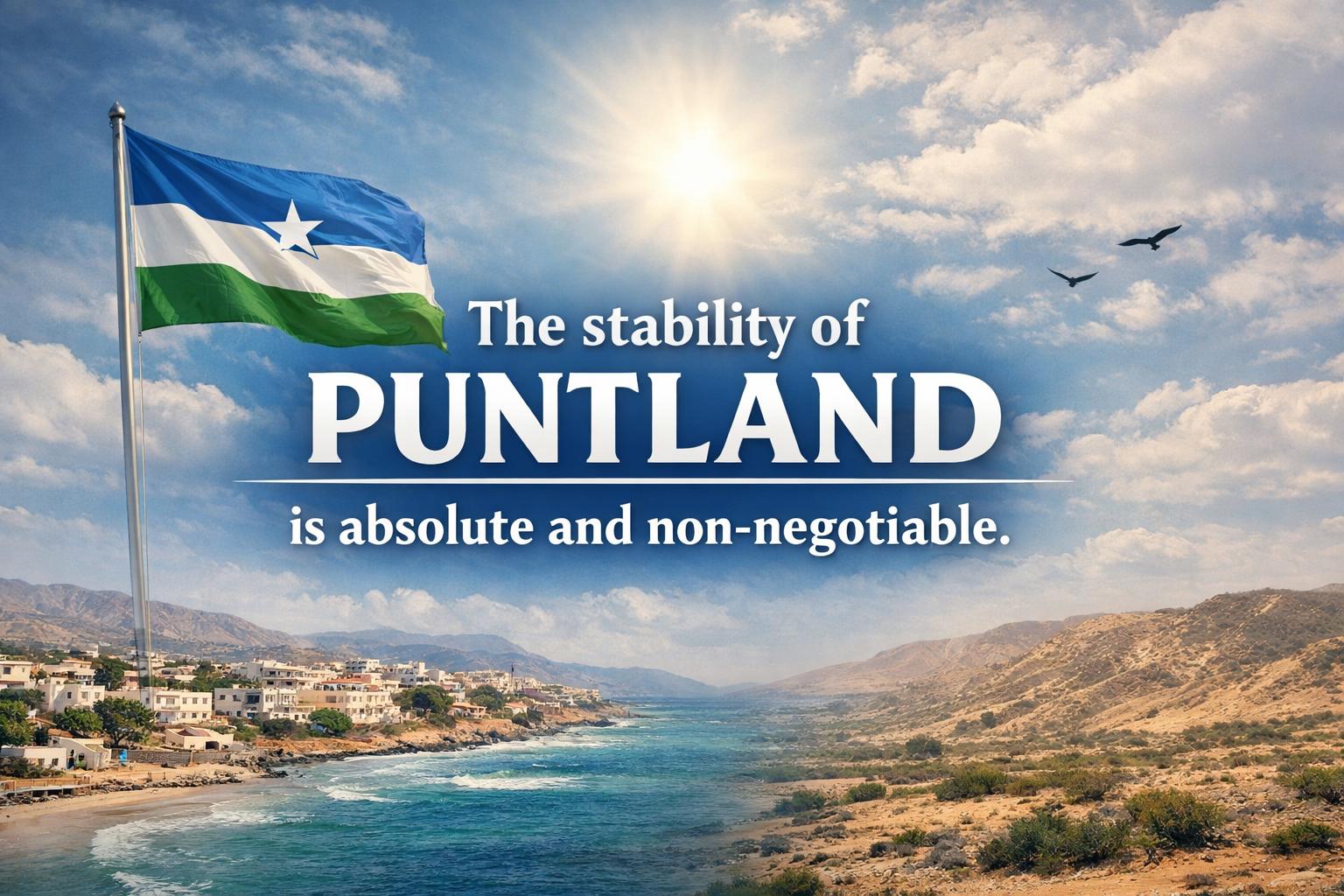

The Federal Government of Somalia’s unilateral effort to restrict Puntland’s external security and economic partnerships is not merely politically misguided; it is strategically hazardous and constitutionally indefensible.
At its core, the directive undermines Somalia’s federal compact by circumventing constitutional procedures and disregarding the autonomy expressly afforded to federal member states. Article 4.3 of Puntland’s Constitution clearly authorizes Puntland to exercise sovereign decision-making in matters directly related to its security, governance, and economic stability.
Equally concerning is the deliberate effort to marginalize the United Arab Emirates, a pivotal partner that has made sustained and tangible contributions to Puntland’s security architecture, counter-terrorism operations, infrastructure development, and economic resilience. Undermining this partnership risks creating security vacuums at a critical moment—particularly given Puntland’s recent successes in defeating ISIS and Al-Shabaab elements in the Galgala and Calmis Gaad Mountains, achieved with essential support from the UAE, the United States, and regional partners, including Ethiopia.
Energy Governance as a Vector of Geopolitical Influence
Viewed through a broader geopolitical and economic lens, the risks become even more pronounced. President Hassan Sheikh Mohamud appears intent on reshaping foreign influence in Somalia by facilitating an expanded Turkish military presence near Laas Qoray, in close proximity to Bosaso, Puntland’s principal commercial and maritime hub, alongside far-reaching economic concessions.
Turkey has been granted access to approximately 95 percent of Somalia’s oil and gas resourcesthrough agreements concluded without parliamentary ratification, without federal member state approval, and without transparent contractual safeguards. In fragile states, energy governance is inseparable from security: control over hydrocarbons shapes military basing rights, political leverage, and long-term strategic alignment. The reported transfer of Somalia’s national oil and gas geological database to Turkey—without compensation or competitive process—represents a major geopolitical concession, not merely an economic agreement.
This concern is especially acute for Puntland. Significant hydrocarbon reserves within Puntland were surveyed between 1960 and 1990 by American and international energy companies, including Shell and Kaneco, at considerable financial and technical cost. The unilateral handover of this data—produced through decades of investment—undermines property rights, investor confidence, and established norms of resource governance.
Simultaneously, Qatar, frequently cited in regional security assessments for alleged indirect links to extremist financing, may seek to exploit this strategic realignment, potentially enabling the reconstitution of terrorist networks previously dismantled in Puntland.
Maritime Security and Global Implications
Puntland’s security concerns extend far beyond regional politics. The region administers over half of Somalia’s coastline, spanning both the Indian Ocean and the Gulf of Aden, one of the world’s most strategically vital maritime corridors. Key navigation infrastructure—including lighthouses along Puntland’s coast—ensures the safe passage of commercial vessels and energy tankers. Any deterioration in Puntland’s security would therefore have immediate and cascading international consequences.
Puntland’s proximity to Yemen places it directly opposite one of the world’s most volatile conflict zones. The continued operational capability of the Houthi movement, combined with the persistent threat posed by Al-Shabaab and ISIS affiliates, creates a highly destabilizing environment. If Puntland’s coastal security were weakened, maritime militant groups could exploit this proximity to establish cross-Gulf operational linkages, transforming the Gulf of Aden into a contested maritime theater.
Such convergence of extremist networks could manifest in several destabilizing ways:
Maritime Terrorism: Coordinated attacks on commercial vessels, oil tankers, and port infrastructure using small boats, drones, or naval mines. Control of navigation points, such as lighthouses, would amplify their capacity to disrupt shipping safely.
Piracy-Terror Nexus: Weak coastal governance could enable the resurgence of piracy, now intertwined with terrorist logistics and financing networks.
Weapons and Fighter Mobility: Puntland’s coastline could be exploited as a transit corridor for arms, fighters, and illicit financing between Yemen and East Africa, further regionalizing conflict.
Energy Route Disruption: The Gulf of Aden connects the Indian Ocean to the Red Sea and the Suez Canal. Any disruption threatens global energy supply chains and increases shipping costs worldwide.
The consequences would be immediate and measurable. Insurance premiums for shipping through the Gulf of Aden would surge, naval deployments would increase, and global supply chains—particularly for energy and food—would face delays and price volatility. For Europe, Asia, and the United States, this translates into higher energy costs, inflationary pressure, and increased defense commitments.
Critically, Puntland has historically served as a buffer zone against such scenarios. Its cooperation with international partners, coupled with control over strategic maritime infrastructure such as lighthouses and ports, has prevented extremist groups from gaining sustained maritime access. Undermining Puntland’s security partnerships or weakening its coastal governance would remove this buffer, creating a permissive environment for extremist convergence.
Political Fragmentation and Strategic Alliances
President Hassan Sheikh Mohamud’s actions and alliances raise serious concerns regarding Somalia’s federal cohesion and security stability. Rather than promoting national unity, his policies—particularly those targeting Puntland, Jubaland, and other federal member states—appear focused on consolidating political influence. If Somali unity were genuinely a priority, initiatives that undermine the security and sovereignty of key regions would not be pursued.
Reports indicate that Hassan’s strategic decisions may be influenced by external actors, including President Ismail Omar Guelleh of Djibouti, whose longstanding regional ambitions may shape Somalia’s internal power dynamics. This alignment risks directing federal decisions toward narrow political objectives rather than the broader national interest.
Historical precedent demonstrates that efforts to consolidate power through coercion, opaque economic deals, and marginalization of regional stakeholders accelerate political fragmentation rather than foster cohesion. Somaliland’s trajectory provides a clear warning. Targeting Puntland and Jubaland—particularly by undermining their security partnerships and resource governance—risks pushing Somalia further toward fragmentation instead of unity.
Conclusion
The stakes are international in scope. A compromised Puntland would constitute not merely a domestic Somali crisis, but a direct threat to regional and global stability. For this reason, the United States, the European Union, and other major international stakeholders must act decisively—through diplomatic, legal, and strategic engagement—to restrain the Federal Government’s destabilizing trajectory before irreversible consequences emerge.
Puntland’s security, governance, and control over key maritime infrastructure—including lighthouses—are critical to global maritime safety. Its territorial integrity must remain inviolable.
JQ.