
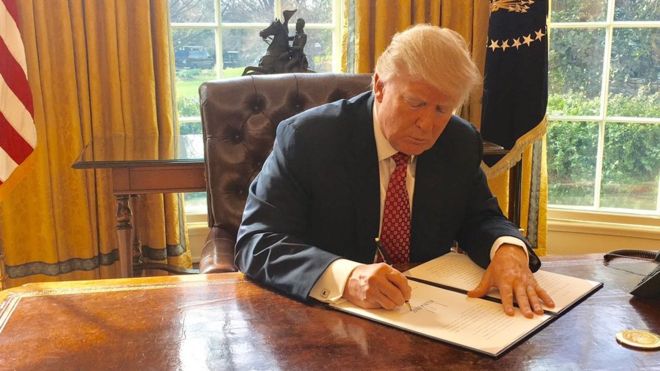

President Donald Trump has signed a new executive order placing a 90-day ban on people from six mainly Muslim nations.
Iraq – which was covered in the previous seven-nation order – has been removed from the new one after agreeing additional visa vetting measures.
The directive, which includes a 120-day ban on all refugees, takes effect on 16 March.
The previous order, which was blocked by a federal court, sparked confusion at airports and mass protests.
Presented as a means to strengthen national security against terror threats, it was blocked by the courts and effectively remains on hold.
The new order was unveiled by Secretary of State Rex Tillerson, Attorney General Jeff Sessions and Department of Homeland Security John Kelly.
“The fact remains that we are not immune to terrorist threats and that our enemies often use our own freedoms and generosity against us,” said Mr Kelly.
In justifying the refugee ban, Mr Sessions said there are more than 300 refugees under investigation for potential terror offences. But no further details were given.
What is different about the new order?
Citizens of Iran, Libya, Syria, Somalia, Sudan and Yemen, the other six countries on the original 27 January order, will once more be subject to a 90-day travel ban.
Iraq has been taken off the banned list because its government has boosted visa screening and data sharing, White House officials said.
The new directive says refugees already approved by the State Department can enter the US. It also lifts an indefinite ban on all Syrian refugees.
Green Card holders (legal permanent residents of the US) from the named countries will not be affected.
The new order does not give priority to religious minorities, unlike the previous directive.
Critics of the Trump administration had argued that this was an unlawful policy showing preference to Christian refugees.
What does the administration say?
Secretary of State Rex Tillerson, Attorney General Jeff Sessions and Homeland Security Secretary John Kelly held a joint news conference on Monday morning to discuss the new directive.
America’s top US diplomat said the order was meant to “eliminate vulnerabilities that radical Islamic terrorists can and will exploit for destructive ends”.
Mr Sessions said that, according to the FBI, more than 300 people who entered the US as refugees are under investigation for potential terrorism-related offences.
The top US prosecutor said three of the countries were state sponsors of terrorism.
The other three, Mr Sessions said, had lost control of territory to militants such as the Islamic State group or al-Qaeda.
Mr Kelly added that unregulated and unvetted travel was putting national security at risk.
He said the US cannot tolerate “malevolent actors using our immigration system to take American lives”.
None of the cabinet secretaries took any questions after the press conference.

Analysis – Anthony Zurcher, BBC News, Washington
Donald Trump has, at last, unveiled his new immigration order, and it looks like government lawyers – and not just White House political operatives like Steve Bannon and Stephen Miller – have had their input.
Gone are the most controversial measures of the old order, such as preference for Christian refugees and the suspension of existing visas and green cards.
The details of the action’s implementation are outlined with greater clarity this time, with more than a week before the new rules kick in.
It’s still an open question as to what, if anything, this order will do to prevent violent attacks on US soil, given that past high-profile incidents have not involved individuals from any of the six named countries.
Mr Trump had promised bold action on border security, however – the kind of move that would unnerve traditional politicians and anger civil liberties advocates.
Given the early reaction from groups like the ACLU and Democratic leaders, the story is unfolding as expected.
Although Mr Trump’s campaign-rally talk of sweeping Muslim bans are a thing of the past, his supporters will likely revel in the uproar and consider this latest move a campaign promise kept.
Why the delayed implementation?
The new order is set to take effect on 16 March.
White House officials hope the 10 days’ notice will help to avoid some of the chaotic scenes at US airports that occurred on 27 January when the first executive order was announced without warning.
Travellers with valid visas who were in the air at the time found themselves detained by border officials on arrival.
Mr Trump had defended the lack of notice, tweeting that “if the ban were announced with a one week notice, the ‘bad’ would rush into our country during that week”.
Will the new executive order face legal challenges?
Yes. New York Attorney General Eric Schneiderman – the state’s highest ranking law enforcement officer – issued a statement on Monday saying his office is ready to take the Trump administration to court.
“While the White House may have made changes to the ban, the intent to discriminate against Muslims remains clear,” he said.
“My office is closely reviewing the new executive order, and I stand ready to litigate – again – in order to protect New York’s families, institutions, and economy.”
The American-Arab Anti-Discrimination Committee (ADC), an Arab-American grassroots civil rights organisation, immediately called for donations to fight impending legal battles ahead.
“The ban is about xenophobia and Islamophobia,” the group said in a statement to the BBC.