
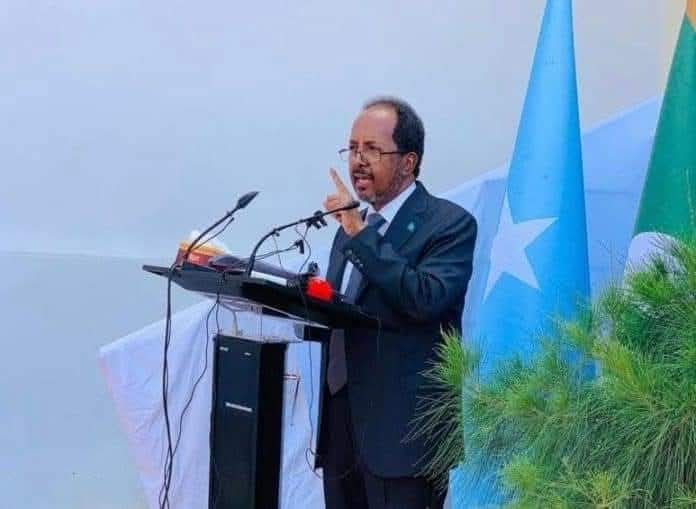

The term of President Hassan Sheikh Mohamud ended on May 15 without a comprehensive political settlement between the Federal Government, opposition actors in Mogadishu, and key Federal Member States including Puntland and Jubaland. At the same time, new tensions and flare-ups are emerging in the South West State and Galmudug.
This is no longer simply a constitutional disagreement.
It is becoming a national security crisis.
Somalia now faces the convergence of multiple dangerous fault lines simultaneously:
- unresolved legitimacy disputes,
- federal fragmentation,
- weakening cohesion of security structures,
- expanding geopolitical rivalry,
- Red Sea and Persian Gulf militarization,
- and Al-Shabaab’s continuing operational resilience.
The regional and international environment has also changed dramatically.
The widening conflict environment stretching from the Persian Gulf to the Red Sea has transformed the Horn of Africa into part of a single strategic theater involving the United States, Israel, Iran, Turkey, Egypt, Gulf states, Ethiopia, and other external powers.
Somalia’s coastline, ports, airspace, and political alignments now carry major geopolitical significance.
Turkey has emerged as the most influential external actor supporting the Federal Government through military training, infrastructure management, and security cooperation. However, as Somalia’s internal political divisions deepen, Turkish influence is increasingly being viewed through the lens of Somalia’s internal political struggle rather than purely national state-building.
Meanwhile, Al-Shabaab continues to benefit from every delay, every division, and every weakening of national cohesion.
The greatest danger is not necessarily an immediate military collapse.
The greatest danger is paralysis.
A fragmented political order, divided command structures, competing external alignments, and weakening trust between Mogadishu and regional states could gradually create multiple competing political-security zones across Somalia.
A northern sphere centered around Somaliland and Puntland.
A contested south-central zone vulnerable to insurgent expansion.
And a semi-autonomous Jubaland security bloc balancing between cooperation and strategic separation.
This could evolve into a de facto partition of Somalia even without formal declarations.
If Somali stakeholders fail to reach a minimum political-security understanding, Somalia risks entering a prolonged period of fragmentation in which:
- federal authority weakens,
- regional entities deepen autonomous security behavior,
- external actors engage through competing channels,
- and Al-Shabaab exploits the resulting vacuum.
The consequences would extend far beyond Somalia itself.
The security of the Red Sea, Bab el-Mandeb, Indian Ocean trade routes, counterterrorism operations, regional stability, and the wider Horn of Africa would all be affected.
Somalia stands at a decisive crossroads.
The coming months may determine whether the country consolidates into a strategic state—or fragments under the combined pressure of internal division and geopolitical competition.
— Dahir Mire Jibreel