

The history of gas and oil in the Ogaden Basin of Ethiopia’s Somali Regional State is long, complex, and closely tied to politics, conflict, and foreign investment. Early exploration and interest in the basin began almost a century ago when Standard Oil Company conducted the first exploration in the 1920s, but the first major breakthrough came between 1950 and 1970 under Emperor Haile Selassie I.
Foreign companies, including Sinclair Oil Corporation and Tenneco, conducted geological surveys. Early findings suggested natural gas reserves; the two largest finds were the Calub and the Hilala gas fields, but infrastructure and political instability limited development.
Under the Derg socialist government led by Mengistu Hailemariam, energy development was not prioritized in Ogaden. They expelled Tenneco and other Western companies. Control shifted to a Soviet-led expedition, but progress stalled because of security challenges in the region. After the fall of the regime in 1991, Ethiopia reopened the energy sector to foreign companies, and several companies returned.
Malaysia’s Petronas, Hong Kong’s Southwest Energy, and other Western companies secured exploration rights and signed agreements with the Ethiopian government. However, because of security challenges and instability, exploration has been repeatedly disrupted. A major incident occurred in 2007 when the ONLF attacked a Chinese-operated oil field, killing dozens of workers. This event highlighted the risks of operating in the region.
The recent agreement between GCL Energy Investment Limited and the Ethiopian government to develop the Calub and Hilala fields represents a significant milestone and a source of renewed optimism. This achievement, realized despite numerous challenges, marks a historic first for the region, largely attributable to the efforts of GCL Energy Investment Limited and the current Ethiopian administration.
The current administration in Ethiopia, led by Prime Minister Abiy Ahmed, has identified the successful development of Calub as a national imperative, aligning with the nation’s objectives of achieving energy independence and diversifying export revenue streams.
The initial phase of the Ogaden Liquefied Natural Gas (LNG) Project in Calub, with an annual production capacity of 111 million liters, followed by a second phase designed to substantially increase the capacity to 1.33 billion liters per year, establishes the foundation for the development of power generation, fertilizer, and oil refinery facilities, representing a total investment of USD 10 billion, which includes an additional USD 1.5 billion allocated to the fertilizer project.
This presents a significant economic opportunity for one of Africa’s most populous nations and an emerging economic powerhouse. The projected revenue streams have the potential to finance critical infrastructure projects, bolster social programs, and stimulate industrial growth, thereby elevating the nation to an unprecedented level of economic prosperity.
The port of Gara’ad and its viability as an export outlet for Ogaden oil and natural gas
The history of gas and oil in the Ogaden Basin of Ethiopia’s Somali Regional State is long, complex, and closely tied to politics, conflict, and foreign investment. Early exploration and interest in the basin began almost a century ago when Standard Oil Company conducted the first exploration in the 1920s, but the first major breakthrough came between 1950 and 1970 under Emperor Haile Selassie I.
Foreign companies, including Sinclair Oil Corporation and Tenneco, conducted geological surveys. Early findings suggested natural gas reserves; the two largest finds were the Calub and the Hilala gas fields, but infrastructure and political instability limited development.
Under the Derg socialist government led by Mengistu Hailemariam, energy development was not prioritized in Ogaden. They expelled Tenneco and other Western companies. Control shifted to a Soviet-led expedition, but progress stalled because of security challenges in the region. After the fall of the regime in 1991, Ethiopia reopened the energy sector to foreign companies, and several companies returned.
Malaysia’s Petronas, Hong Kong’s Southwest Energy, and other Western companies secured exploration rights and signed agreements with the Ethiopian government. However, because of security challenges and instability, exploration has been repeatedly disrupted. A major incident occurred in 2007 when the ONLF attacked a Chinese-operated oil field, killing dozens of workers. This event highlighted the risks of operating in the region.
The recent agreement between GCL Energy Investment Limited and the Ethiopian government to develop the Calub and Hilala fields represents a significant milestone and a source of renewed optimism. This achievement, realized despite numerous challenges, marks a historic first for the region, largely attributable to the efforts of GCL Energy Investment Limited and the current Ethiopian administration.
The current administration in Ethiopia, led by Prime Minister Abiy Ahmed, has identified the successful development of Calub as a national imperative, aligning with the nation’s objectives of achieving energy independence and diversifying export revenue streams.
The initial phase of the Ogaden Liquefied Natural Gas (LNG) Project in Calub, with an annual production capacity of 111 million liters, followed by a second phase designed to substantially increase the capacity to 1.33 billion liters per year, establishes the foundation for the development of power generation, fertilizer, and oil refinery facilities, representing a total investment of USD 10 billion, which includes an additional USD 1.5 billion allocated to the fertilizer project.
This presents a significant economic opportunity for one of Africa’s most populous nations and an emerging economic powerhouse. The projected revenue streams have the potential to finance critical infrastructure projects, bolster social programs, and stimulate industrial growth, thereby elevating the nation to an unprecedented level of economic prosperity.
However, a landlocked country faces a fundamental challenge: how to transport this precious resource to the international market? While existing ports in neighboring countries offer a solution, the emergence of Gara’ad Port in Puntland represents a compelling, strategic, and potentially superior alternative, capable of creating a powerful regional economic corridor and landscape.
Ethiopia has historically relied on Djibouti’s ports for over 95 percent of its maritime trade. Although this relationship is well established, relying on a single corridor for a strategic commodity like natural gas carries inherent risks, particularly in terms of political influence, congestion, and cost. This necessity has prompted Ethiopia to actively seek alternative port access, making the development of the Puntland Economic Corridor a major foreign policy objective as it provides a logistical route for Ethiopia primarily by offering a diversified maritime gateway that reduces the landlocked nation’s dependence on other regional ports.
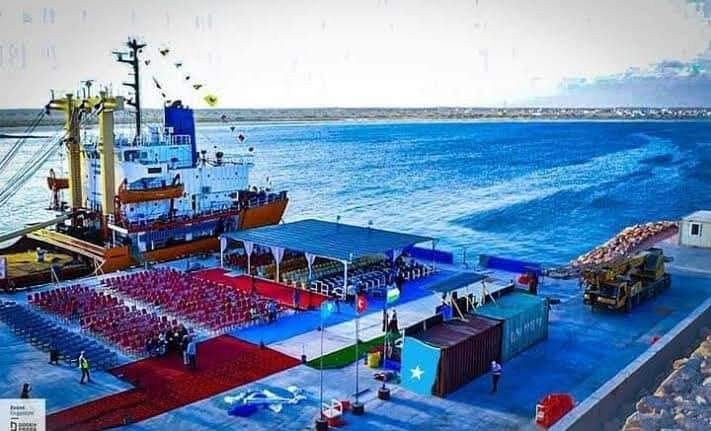
Gara’ad (Garacad) Port is a new multi-purpose port under development on the central coast of Somalia’s Puntland region. It is not just another port; its potential for Kalub gas is rooted in a combination of geographical, economic, and strategic factors. The most significant advantage Gara’ad offers is its location. It lies almost 472 km directly east of the Kalub gas field. A pipeline from Kalub to Gara’ad would be one of the shortest possible routes to the sea, traversing relatively flat terrain in the Somali Regional State of Ethiopia and into Somalia’s Puntland regional state. A pipeline to Gara’ad would be significantly shorter than one extending to Djibouti or even Berbera in Somaliland.
In pipeline construction, a shorter distance means lower capital expenditure and lower operational costs over the long term. This directly increases the profitability of the Kalub gas project. When it comes to natural gas and oil, unlike the multi-purpose and often congested ports, Garacad is being developed with the vision of handling bulk commodities, including hydrocarbons. This means its infrastructure, such as loading terminals, storage facilities, and security, can be specifically designed for the efficient and safe export of LNG and CNG. While constructing an LNG liquefaction plant is capital-intensive, Gara’ad’s location offers a stable coastal site for such a facility. Gas would be piped directly from Kalub, liquefied, and loaded onto specialized LNG carriers for global export.
The pipeline route and the port itself would need to be secured against potential instability or controversy. This requires political and legal frameworks: A comprehensive bilateral agreement between the Federal Government of Ethiopia and the Puntland regional state, with clear roles for the Federal Government of Somalia, is essential. This agreement must transparently address issues of sovereignty, revenue sharing, and transit fees. Detailed feasibility studies are required to finalize the pipeline route, assess environmental impact, and determine the most economical export method (LNG vs. CNG).
Garacad Port is more than just a construction project; it is a symbol of potential. For Ethiopia, it offers the most direct and economically sensible route to monetize its vast Kalub gas reserves, reducing its strategic dependence on a single port and fueling its economic engine. For the Somali Regional State of Ethiopia and Puntland, it represents an unprecedented opportunity for economic development, job creation, and integration into a major international value chain. While the path forward is complex and requires navigating significant political, security, and financial challenges, the potential rewards are too great to ignore. If the stakeholders can build a framework of trust, cooperation, and shared interest, the Kalub-Garacad corridor could become the most significant economic story in the Horn of Africa, turning buried resources into shared prosperity for generations to come.
Khadir Abdirahman Ahmed is a former Supreme Court president of somali regional state, senior advisor of international Committee of Red Cross (ICRC), founder and executive director of Somali Development Association (SDA), deputy Bureau head of somali regional state trade transport and industry and senior staff for several other institutions in somali regional state and international organizations.
Contributed by Khadir Abdirahman Ahmed