
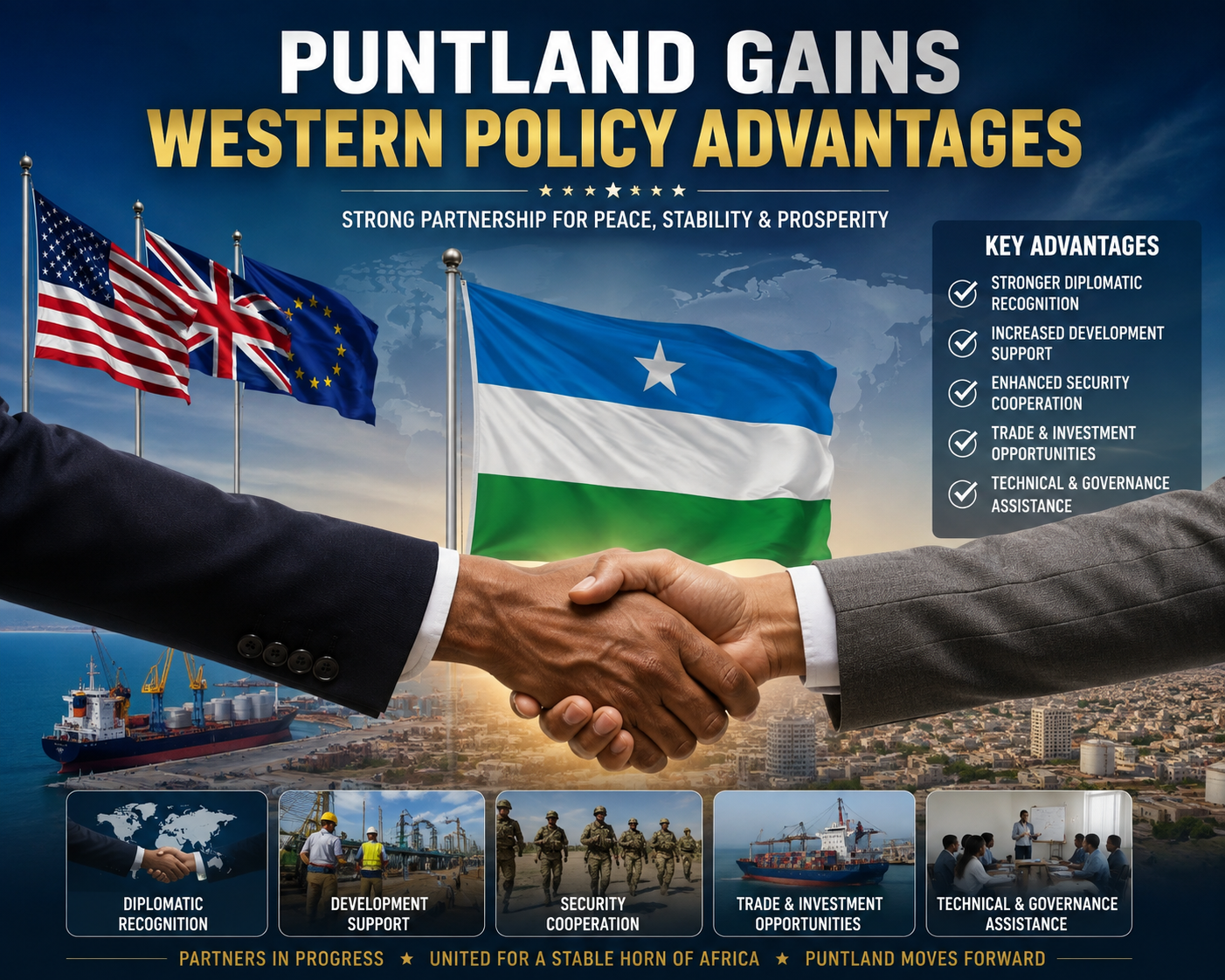

The international community has abandoned the former policy of constructing a meaningful central state based in Mogadishu and has turned instead to a policy of fashioning small, accountable states.
Somaliland, Puntland and the South Somalia are the three republics now being assembled; Jubaland is treated as a separate case from the remainder of Southern Somalia.
What, then, is the new policy?
It sprang from a single purpose: that the world has grown weary of dispensing aid and has moved to a relationship of exchange.
Politicians who hold this view with particular conviction have assumed the leadership of the West, America foremost among them.
The West’s reassessment of its Somalia policy produced the conclusion that it should abandon the project of building a workable central government and should instead deal with those treble entities with which co-operation is possible.
The West, with the United States in the lead, discerned three advantages in the new course.
First, it would staunch the large sums that once passed through the Somalian central government.
Second, to treat as clients the federal member states whose status has been elevated is both cheaper and more rapidly productive than the construction of a Somali central state.
Third, the moment has arrived to derive benefit from Somalia itself, its vital sea lanes, its mineral deposits and its energy resources.
The adoption of this Western policy coincided with a general despair that Somalia would ever produce a central government of substance capable of standing against such a reading of events.
It is a Yugoslav solution.
Somaliland Republic with which one may work: it commands one of the important sea lanes and already possesses a prepared port and airport at Berbera.
Republic of Puntland is a also may work: it commands two important sea lanes, mineral wealth, and a seaboard rich in oil reserves.
South is complicated and may not work, to be shielded from complete capture by terrorists or from the entry of China and Russia; Turkey has been charged with that task.
Jubaland is handled as a special case and is left to Kenya.
As for Turkey and the South: Turkey is one of the instruments America employs, especially under President Trump. Familiarity with President Erdoğan’s susceptibility to persuasion is the reason Mr Trump instructed the State and Defence Departments to keep their hands off Turkish interests in southern Somalia.
Even so, those two departments continue to work so that Turkish interests in the South shall not prevail.
Turkey’s policy, founded upon authoritarian rule, and that of the Mogadishu politicians who believe in a single-city state and have appropriated one another, seek together to seize the entire country and to overcome the political visions of Puntland and Somaliland.
Southern Somalia therefore confronts policies that move in the same general direction yet collide with one another.
Puntland and the new policy: in truth, Puntland, having grown disillusioned with the Federal Government it helped to create and having failed to realise its ambition of a nation whose capital would be held in common, has found in the present moment an opening.
It has obtained the chance to correct its course and to reassess, in the light of the experience gained from building the Federal Government and from Mogadishu’s claim to the capital.
Powers that it had transferred with little experience and much emotion have returned to it with ease.
The policy of treating Somali entities as clients—now stronger than the earlier two-faced arrangement, elevated to the standing of independent republics, and based upon exchange rather than upon aid and state-building—has come back.
The greatest success so far is the maritime-security agreement signed between the United States and Puntland: co-operation against terrorism and crime, and military partnership that includes the establishment of a base.
Puntland now has the opportunity to take one of two roads of its choosing.
The first is the reconstitution of a Fourth Somali Republic whose capital is not Mogadishu and which is not federal.
The second is to relinquish the idea of a unifying Somali nation and to continue as a client of the international community until, when the world’s interests in it have grown sufficiently strong, it attains the status of a recognised republic.
President Deni, who has arrived at this point of transition, faces decisions of a fateful kind.
IDILNEWS