
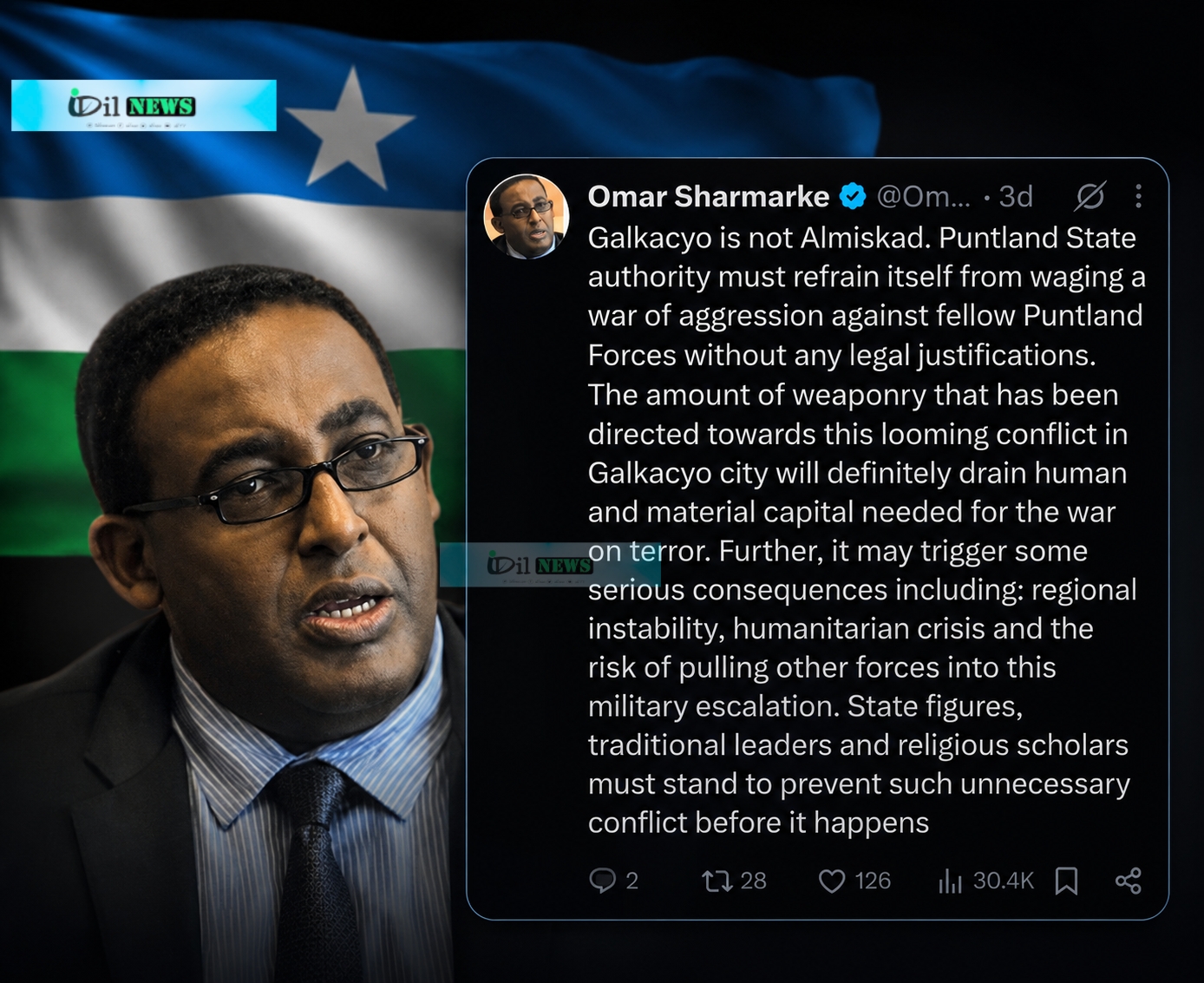

In Response to the Statement on X on Galkacyo and Puntland by Former Somali
PM, Mr Sharmake
By A M Yusuf (Educator and socio-political analyst based in London, UK)
The recent statement by former Somali Prime Minister Cumar Cabdirashid Cali Sharmarke
asserting that “Galkacyo is not Calmiskaad” deserves a thoughtful but firm response. While the phrase is factually correct on its face, its political implication carries a more troubling and sinister
connotation that risks obscuring the realities of Puntland’s role in safeguarding security, stability, and peace across Somalia and the wider Horn of Africa.
No serious observer disputes that Galkacyo is not Calmiskaad. However, the comparison ignores one fundamental fact: Calmiskaad was invaded, infiltrated, and occupied by ISIS terrorists and extremist elements who sought to establish a foothold in Puntland and threaten the security of the entire region. Puntland’s security forces, backed by the unwavering support of the Puntland population, undertook a determined campaign to flush out those militants from their strongholds. Through sacrifice, courage, and persistence, Puntland restored order and pacified vast areas that had fallen under extremist influence. This is not a matter of political interpretation; it is a matter of public record and a testament to Puntland’s commitment to regional security.
Indeed, Puntland today stands as the only Federal Member State that has consistently
demonstrated an uncompromising commitment to peace and stability not only within Somalia but also throughout the Horn of Africa and among countries bordering the Gulf of Aden. While political actors in Mogadishu remain preoccupied with endless power struggles and electoral calculations, Puntland’s security forces are engaged in the difficult and dangerous task of combating ISIS and other extremist organisations. They are doing so often with limited resources
and, notably, without tangible support from the Federal Government.
The significance of Puntland’s anti-terror operations extends far beyond its borders. The ISIS network operating in northern Somalia does not merely threaten Puntland. It threatens Somalia as a whole, the maritime security of the Gulf of Aden, and the stability of neighbouring countries. Every successful operation conducted by Puntland’s forces contributes to the security of
international shipping routes, regional trade, and the broader fight against transnational
terrorism. Puntland is therefore not merely protecting its own territory; it is providing a vital public good for the entire region.
Against this backdrop, Mr. Sharmarke’s remarks appear particularly misplaced. Galkacyo, unlike Calmiskaad, is a city jointly administered by Puntland and Galmudug. Despite periodic political disagreements, both administrations have managed to maintain practical cooperation and coexistence. The city remains one of the few examples in Somalia where two federal member states share jurisdiction and work collectively for the benefit of their populations. The suggestion that Puntland is somehow seeking conflict in Galkacyo ignores the reality that stability in the city serves Puntland’s interests far more than instability ever could.
It is also worth recalling history. Mr. Sharmarke served as Prime Minister during President Xasan Sheekh Maxamuud’s first administration when violent clashes erupted in Galkacyo between Puntland and Galmudug forces. During that period, many political leaders and members of the Puntland public believed that the federal government did little to de-escalate the tensions. Indeed, suspicions were widespread that President Xasan Sheekh’s administration viewed the conflict through a political lens rather than as a national crisis requiring impartial mediation. Whether those suspicions were justified or not, they became deeply rooted in Puntland’s political consciousness.
Today, many Puntlanders are observing developments with a sense of déjà vu. History appears not merely to be repeating itself but, as the saying goes, to be rhyming. Statements that appear to question Puntland’s security measures while simultaneously downplaying external interference inevitably revive memories of earlier periods of tension and mistrust between
Puntland and the federal leadership.
From this perspective, Mr. Sharmarke’s intervention seems to embody the Somali proverb, “Fiqi tolkii kama janno tago”—a religious leader does not abandon his own people even when entering paradise. The implication is that loyalties and political alignments often shape public positions. Many Puntlanders view the former Prime Minister’s comments through precisely this lens. Equally important is the question of security and jurisdiction. Puntland, like any functioning administration, has every right and responsibility to ensure that armed forces operating within its territory fall under its lawful authority. No state can tolerate the existence of parallel military structures outside its command and control framework. Militias operating in Bosaso, Galkacyo, or elsewhere under the former PSF designation must ultimately be integrated into Puntland’s official security architecture. Anything less creates confusion, weakens institutional authority, and opens the door to instability. A fragmented security system benefits neither Puntland nor Somalia.
The broader political context cannot be ignored either. Many in Puntland and Jubbaland believe that President Xasan Sheekh Maxamuud’s ultimate objective is to create politically compliant administrations across the federal member states, similar to arrangements perceived to exist in South West State and Hirshabelle, with similar ambitions reportedly extending toward Galmudug. Whether this perception is entirely accurate is secondary to the fact that it is widely held among significant segments of the Puntland and Jubbaland political establishments.
What is increasingly clear, however, is that such ambitions will encounter resistance in Puntland and Jubbaland, where strong regional identities, established institutions, and politically engaged populations place a premium on autonomy within the federal system. Politicians from Puntland and Jubbaland who choose to support efforts perceived as undermining their states’ constitutional authority may gain temporary favour in Mogadishu, but they risk permanently damaging their credibility at home. In the long term, aligning with policies viewed as detrimental to regional interests could prove politically catastrophic.
IDILNEWS